Before we get into today’s history lesson, let us place where we are on the world’s map (BTW, my copilot is somewhat worried you might be getting a little tired of all the history lessons). We leave Jasper, AB on the northern end of the Icefield Parkway. Not to continue to belabor the point, but the smoke still obscures most of the scenery. We are most pleased we have had the opportunity to see the area on several previous occasions. Because of the smoke, we made the decision to depart the Parkway about midway and head east. This will get us out of the smoke and enable us to explore a place Meriam has wanted to visit – the Rocky Mountain House (and no, this is not a pub or bar)! Actually, the official name is Rocky Mountain House National Historic Site.
Rocky Mountain House was the furthermost western trading post for The North West Company. Little remains of the original trading post, but its significance helped shape the political boundaries between the US and Canada.
Rocky Mountain House served as a base for the Canadian explorer and mapmaker, David Thompson (1770-1857). He was commissioned by The North West Company to explore and map the vast areas of the northwest – all of this set against the broad canvas of dramatic rivalries between the United States and British North America; between the Hudson’s Bay Company and its Montreal-based rival, the North West Company; and among the various Indian tribes thrown into disarray by the advent of guns, horses, and alcohol.
Less celebrated than his contemporaries Meriwether Lewis and William Clark, Thompson spent nearly three decades, beginning in 1784, surveying and mapping more than 1.2 million square miles of largely uncharted Indian Territory. Traveling across the prairies, over the Rockies, and on to the Pacific, Thompson transformed the raw data of his explorations into a map of the Canadian West. Measuring ten feet by seven feet and exhibiting astonishing accuracy, this map became essential to the politicians and diplomats who would decide the future of the rich and promising lands of the West. Yet he worked without personal glory and died in penniless obscurity.
On one of our previous trips, Meriam read the book entitled Epic Wanderer. It is an excellent biography of this amazing man. It was because of her interest in David Thompson that we visited Rocky Mountain House.

Out hiking, Meriam and I came upon some of her “friends”, this family of Canadian geese.

Have we mentioned anything about the smoke, LOL? This is not the moon but the sun at around 10:00a.

Athabasca Falls on the Icefield Parkway. Viewing these magnificent falls, we recall from the book Epic Wanderer, by D’Arcy Jenish, the significance of Thompson forging these falls on his way to Athabasca Pass, his route west through the Rocky Mountains. Again notice the effect of the smoke. You can barely make out the mountain just below the sun (this was around 11:00a).

There is very little left of the original Rocky Mountain House. Here we see the impression of the original fort. Archeologist left their diggings uncovered so one can see the original footprint.

A replica of one of the four forts originally built on the site.

Oh No! As if MB doesn’t have enough hand working projects, she decides to take up traditional beading!
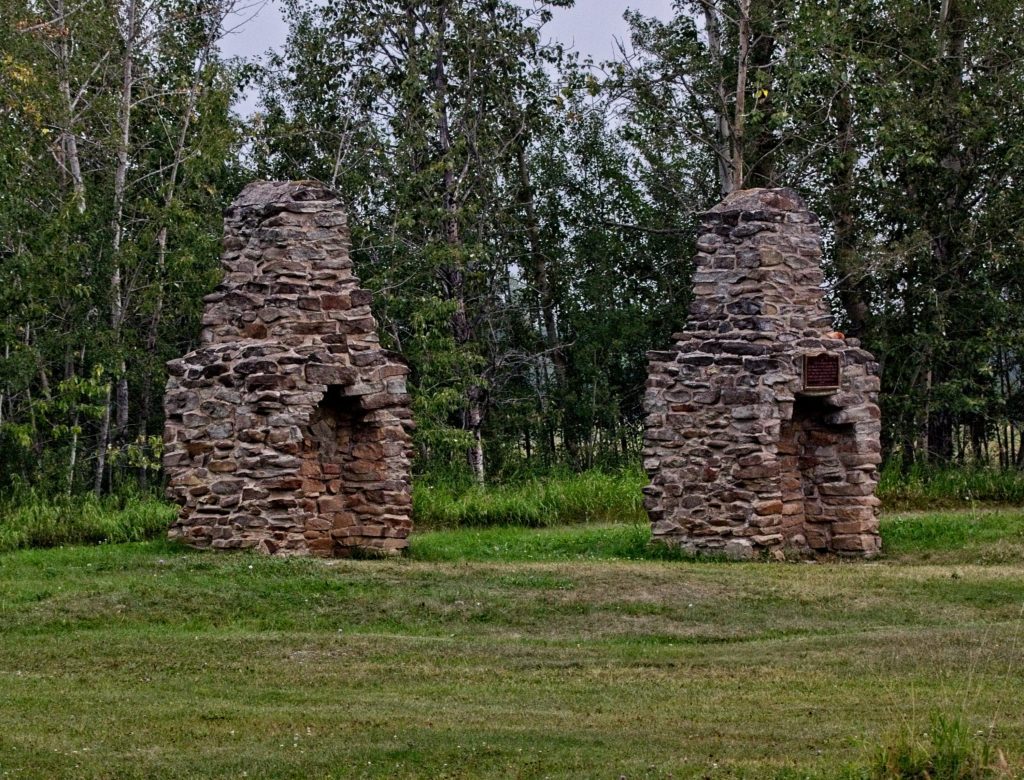
These two stone fireplace hearths are the only remaining original structures from another of the four forts at Rocky Mountain House.
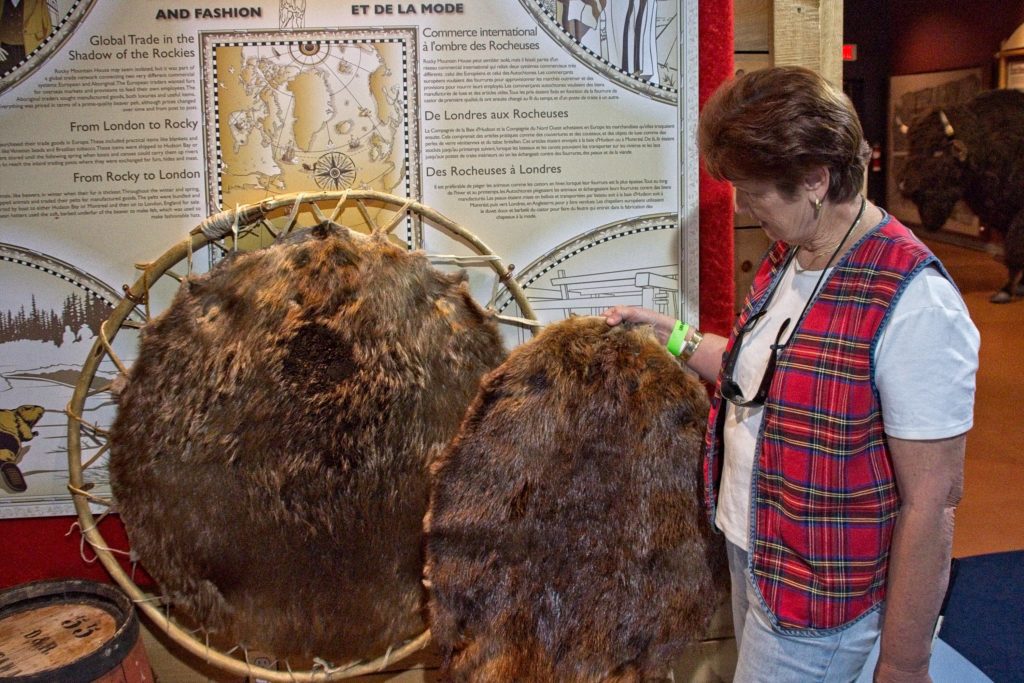
As perhaps you will recall, “it was all about beavers”! The quest for beaver pelts basically drove the exploration of North America. Here Meriam inspects a pelt in the museum.

This is a replica of David Thompson’s original “great map”. Apparently, cartographers are still finding “secrets” hidden it its detail.
diana Wallaboggles the imagination how someone created maps like this so long ago without a satellite!!! Also … love the smokey sun photos. Diana
HaroldHave u visited the Time and Measurement Museum in Jefferson? He can explain how they did it back then.