28 July 2016
Upper Canada Village
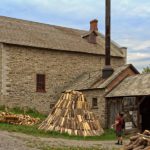
We finally leave the War of 1812 behind (and we are sure some of you are most pleased) and move forward in time to the 1870s. We visited Upper Canada Village, a living history town depicting the Victorian period of Canada.
Upper Canada Village was never actually a “real” village. In the later 1940s, the government of Canada decided to widen the St. Lawrence waterway in this Upper Canada area. In doing so, they flooded a number of a farm homes and their land. As compensation to those displaced by the flooding, the government built Upper Canada Village, providing work for those who lost their livelihood.
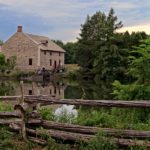
Almost all living history museums of this period invariably have some repetitive components such as blacksmiths, tinsmiths, sawmills, etc. However, what attracted us to Upper Canada Village were three historically significant mills which had been moved to this site. All three (structures as well as interior working components) are intact and remain water powered.
(Editor No. 2: Well, we didn’t exactly leave the War of 1812. It seems Upper Canada Village is located next to the site of Crysler Farm (yes, this is how they spell Chrysler here) where the Americans were so summarily defeated!)
(Editor No. 1: Since No. 2 has her say, I will interject something. Having visited quite a few Canadian museums, etc. over the years, we have been most impressed by the abundance of staffing associated with virtually every one. This abundance of staffing could not be supported by admission fees alone. Some government subsidies would be necessary…no different than in the US. However, this prompted me to research the percentage of workforce working directly for the governments of Canada and the US. As we know, the US government workforce is expanding and currently stands at about 13% of all US workers. The Canadian percentage is almost 28%.)
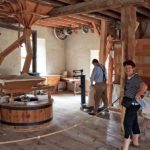
These first set of photographs are from the Woolery factory. Care to guess who scoped this out!
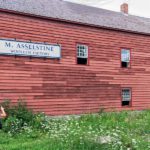


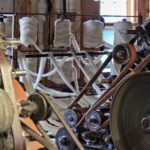


Fine “modern” machinery at work! Here they are “carding” wool, getting it ready for the spinning loom.
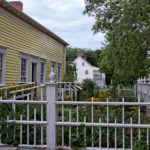
The following photographs are other scenes from the village. Take particular note of the photograph with the children. They are actually here participating in a summer learning program.