Building the Continental Railroad -Part 2, Golden Spike National Historic Park
Golden Spike National Historic Site was set aside by Congress to document and explain the importance and construction of the nation’s first transcontinental railroad. The site, as it exists today, is as historically accurate as reasonably possible, including the daily reenactment of the meeting of the eastbound Central Pacific train and the westbound Union Pacific train.
This location is, of course, Promontory Summit, Utah. May 8, 1869, was the date agreed upon to complete the railroad. The Central Pacific dignitaries, led by railroad president Leland Stanford arrived the evening of May 7th. Dr. Thomas Durant, vice-president of the Union Pacific, wired ahead that his party was unavoidably delayed. What he did not say was that his train was chained to a siding in Piedmont, Wyoming Territory, by his own contractors who had not been paid in over four months. Durant wired for enough money to pay the workers and the ceremony took place two days later on May 10th.
Frank Leslie, a reporter for the Illustrated Newspaper of the period quoted “A journey over the plains was a formidable undertaking that required great patience and endurance. Now all is changed”. To get a feel for the impact of the completed railroad on Americans of this era, consider:
Early westward travelers had a choice of a six-month passage by sailing ship around South America,
A five-to-seven-month walk along a wagon train, or
A jarring twenty-four-day ride in a stagecoach.
Each option was expensive and dangerous. In 1870, for a first-class train fare of $100, the passage between Omaha and Sacramento took just four and one-half days in comparative comfort.
So back to today’s ceremony. But first, why was Promontory Summit picked for the meeting of the two railroads? It seems as the two railroad companies began getting closer to each other, neither Congress nor President Grant could decide where the two should meet. Finally, Promontory Summit was chosen. Delay in choosing the site resulted in the two companies grading out more than 250 miles past each other. While railroad tracks were not laid in this extra mileage, the cost was still substantial.
Editor’s Note: In preparation for this visit to Golden Spike, Meriam and I have read two books that provide factual information regarding the building of the Transcontinental Railroad. The first book was “Nothing like it in the World”, by Stephen Ambrose. This is an excellent book and an easy read. The second book was “Ghosts of Gold Mountain”, by Gordon Chang. This book tells the stories of the more than 20,000 Chinese who provided most of the labor in building the Central Pacific Railroad.
Editor’s Second Note: There are two different auto tours one can take which follow a portion of the original railroad. One tour comes from the west as it approaches Promontory Summit. The other travels east as you leave Promontory. Unfortunately for is, campers and trailers are prohibited on each route (because several of the tunnels and/or curves in the track will not accommodate extended length or extra wide vehicles.)
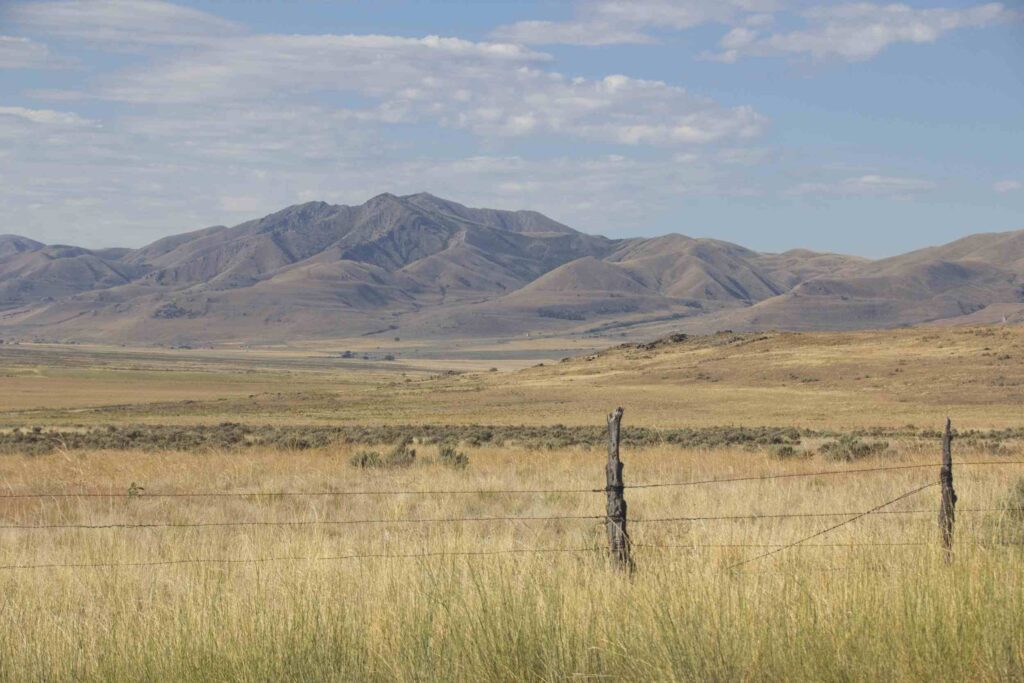
A view of the somewhat desolate country near Promontory Summit.
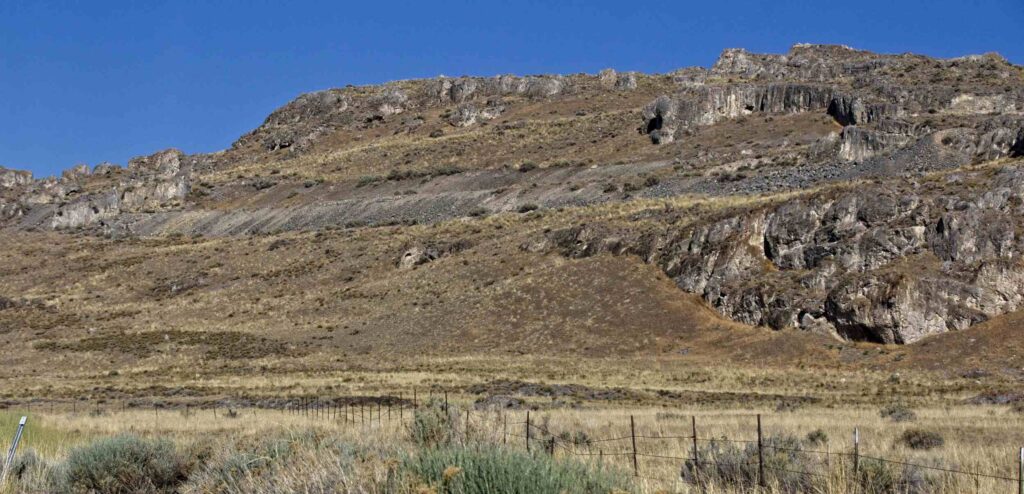
Though somewhat difficult to see, there are two filled and graded tracks here. This is known as the Big Fill. Notice the somewhat level line of the grayish area. This area, all the way down to the lower part of the photograph, was hand filled by several thousand Chinese workers of the Central Pacific. The flat area above the Central Pacific’s grade was created by laborers of the Union Pacific where a trestle was then erected. So why two grades? Recall the discussion above about the extra 250 miles of grade created by the two companies? This is part of that mileage! (A photograph from above is much more impressive of the work required to complete the Big Fill. Unfortunately, we had neither plane nor drone with us.)
The exhibit area at the park was informative. Depicted here are actual rails, rail components, ties, and gravel from the original rails. The beam connecting the rails is not old but illustrates the device used to make sure the distance between the rails was always consistent.
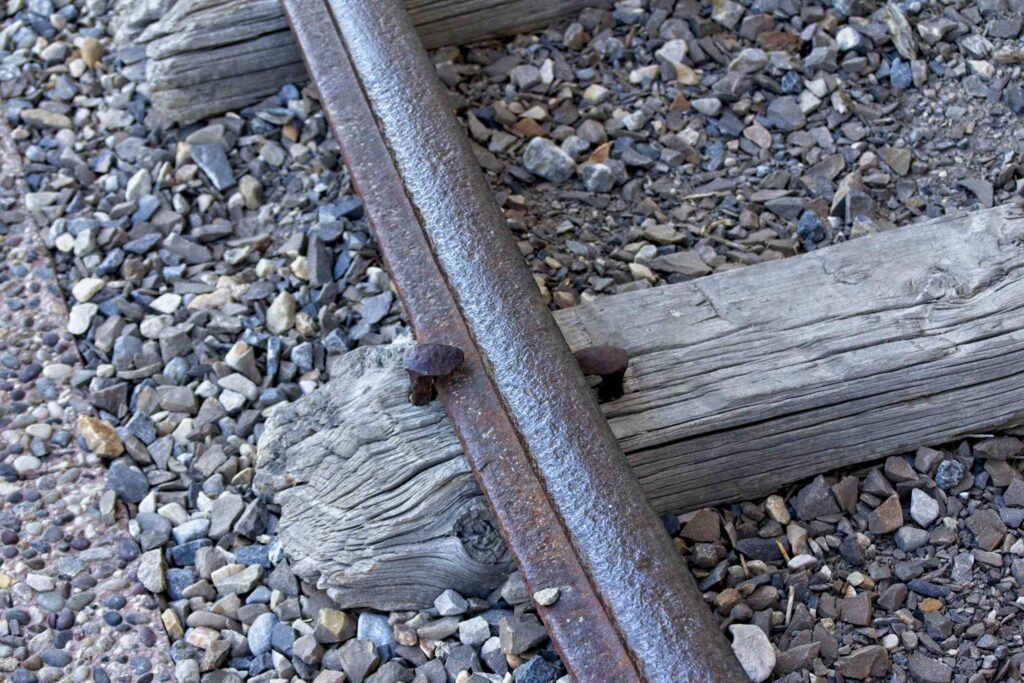
Another example of authentic rails, ties, and spikes.
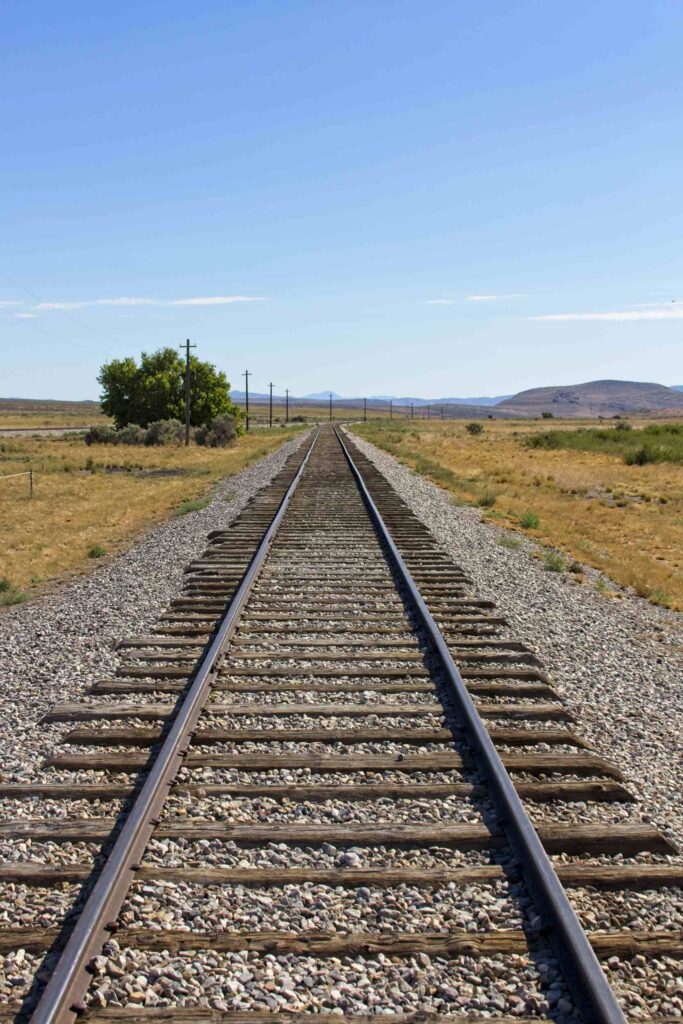
While these rails (made from steel) and ties are not authentic (the original rails were made from iron and lasted less than a year or two), they lay on the original site. These rails represent those of the Central Pacific.
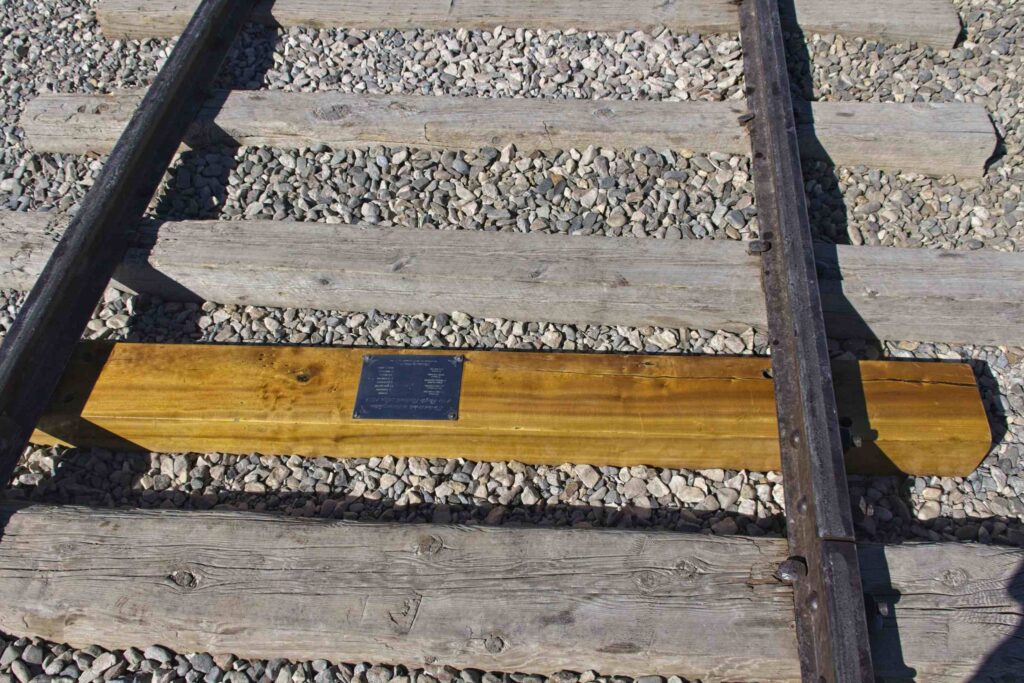
Again, while not original, the new, yellowish tie lies in the exact spot where the golden spikes were driven.
The Central Pacific engine No. 60 headed into Promontory.
A closer view of the Central Pacific No. 60. Both the Central Pacific and Union Pacific engines are authentic replicas of the original engines, built-in California in 1975.
The Union Pacific’s engine No. 119. So notice in this photograph, the poles resembling telephone lines. These are actually telegraph lines. The nation’s second transcontinental telegraph was built alongside the advancing rails. This gave the railroads instant communication with their headquarters in Sacramento and Omaha. The rest of the country eagerly followed the progress of each company as mileages were reported over the wires daily. The telegraph also gave dispatchers safer control over the two-way movements of trains on a single track.
A closer shot of the Union Pacific’s No. 119.
The ceremonial meeting of the two railroads. While hard to see here, the two engines puffed out different quantities of smoke. Since the Central Pacific had access to large amounts of timber along most of their route, it burned wood – creating a limited amount of smoke. By comparison, the Union Pacific’s route took them through more plains with little wood available. As a consequence, they burned coal – creating vast amounts of smoke.
As you will notice in some of the previous photographs, there is an American flag flying above one of the telegraph poles. Unfortunately, this flag is authentic to the original happening, but not authentic to the time period of the event. It seems that at the ceremony, neither the Central Pacific nor the Union Pacific thought to bring along a flag. Fortunately, one of the Union Pacific employees pulled a flag from his saddlebags. However, this flag had 20 stars and the then-current flag had 25 stars (we think.) Anyone want to verify (or disprove) the number of stars on our flag in 1869 for us?
A slightly different view of their meeting. In the lower part of the photograph, you will notice another track. This foreground track is a side rail of the Union Pacific. The track the trains are currently on belonged to the Central Pacific. As part of today’s ceremony, the Union Pacific No. 119 arrived first on their track and then backed up and switched to the Central Pacific line for the ceremonial meeting. Since the Central Pacific’s train was designated as a passenger train it had the right-of-way over the Union Pacific’s freight train. As opposed to modern times, back then, passenger trains had the right-of-way over freight trains.
LauraHow interesting! Thank you for posting. ReplyCancel
HaroldAs always, Laura, you are welcome. ReplyCancel
TiffanyI love reading your posts! You do a wonderful job of sharing your adventure and giving an interesting view into the history and importance of the place. ReplyCancel
HaroldTJ, thanks. You know now that you and Deron, are tasked to take over once we can no longer make these treks. ☺️ReplyCancel
VIRGINIA (Ginny) JONESYou have just whetted my appetite to read at least one of the books you’ve recommended. Really…thanks. Ginny ReplyCancel
HaroldGinny, great! I would recommend the Stephen Ambrose book first.ReplyCancel
2.8fastglass@gmail.comWe have enjoyed everything you have posted so far and it seems we are traveling with you step by step because we did the same trip up until now. So, we are looking forward to the rest of your adventure.ReplyCancel
HaroldHey Sam, welcome back! We are camped now at Slough Creek in Yellowstone. We’ve only been here a couple of hours but already love it. Unfortunately, it is extremely difficult to get a site. Recreation.gov has taken over the reservations. When they opened up for reservations, MB and I were immediately on our computers at the opening bell. We were only able to get two nights! Within 5 minutes the entire available reservations were taken. There has not been an open site for the months of June, July, and August. Definitely worth it is one can get a site.ReplyCancel
Weldon W NashThanks so much for the terrific photos of those two beautiful locos. I have a model of each in HO scale. ReplyCancel
HaroldAwesome, you and Mary should take a trip out there. ReplyCancel
MARDEE DESSOMMES Wow those Trains are so cool….ReplyCancel
HaroldMardee, I’m sorry I missed your comment. Thanks for responding. You should put this on your bucket list when you and Chuck retire!ReplyCancel



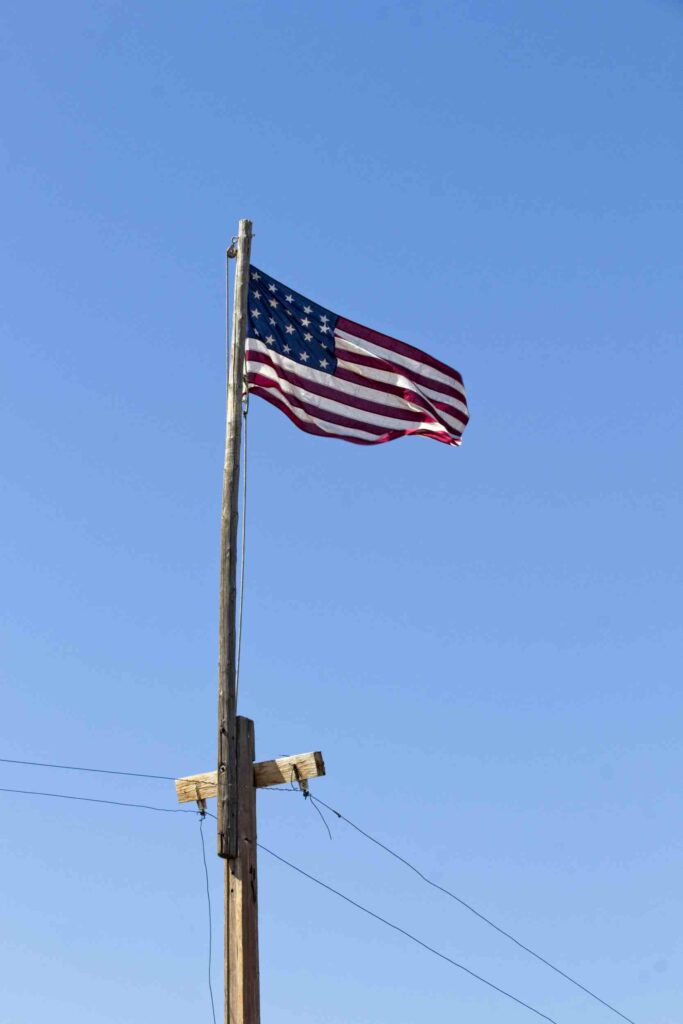

mao According to my google, in 1867-1877 the flag had 37 stars? It is all very interesting.
HaroldWe can alway count on you, MAO
Virginia PeveyWow! Interesting history! Thanks for sharing.
HaroldVirginia, you’re most welcome.
LauraHow interesting! Thank you for posting.
HaroldAs always, Laura, you are welcome.
TiffanyI love reading your posts! You do a wonderful job of sharing your adventure and giving an interesting view into the history and importance of the place.
HaroldTJ, thanks. You know now that you and Deron, are tasked to take over once we can no longer make these treks. ☺️
BobWow! Fascinating history! Thanks!
HaroldThankx, Bob!
VIRGINIA (Ginny) JONESYou have just whetted my appetite to read at least one of the books you’ve recommended. Really…thanks. Ginny
HaroldGinny, great! I would recommend the Stephen Ambrose book first.
2.8fastglass@gmail.comWe have enjoyed everything you have posted so far and it seems we are traveling with you step by step because we did the same trip up until now. So, we are looking forward to the rest of your adventure.
HaroldHey Sam, welcome back! We are camped now at Slough Creek in Yellowstone. We’ve only been here a couple of hours but already love it. Unfortunately, it is extremely difficult to get a site. Recreation.gov has taken over the reservations. When they opened up for reservations, MB and I were immediately on our computers at the opening bell. We were only able to get two nights! Within 5 minutes the entire available reservations were taken. There has not been an open site for the months of June, July, and August. Definitely worth it is one can get a site.
Weldon W NashThanks so much for the terrific photos of those two beautiful locos. I have a model of each in HO scale.
HaroldAwesome, you and Mary should take a trip out there.
MARDEE DESSOMMES Wow those Trains are so cool….
HaroldMardee, I’m sorry I missed your comment. Thanks for responding. You should put this on your bucket list when you and Chuck retire!