Meriam and I have passed through Missoula, MT on a number of occasions, and each time we talk about stopping and visiting the Missoula Smokejumpers. Well, this year we stopped and are MOST pleased we did.
Here are some interesting, general facts regarding Smokejumpers.
There are nine smokejumper bases located strategically throughout the Western United States; all are in close proximity to large, roadless, wildlands.
The Smokejumper program was started in 1939.
There are approximately 400 active smokejumpers in the United States, of which, 56 are stationed in Missoula.
Any of the 9 stations may request assistance from other stations
Of the 56 smokejumpers currently in Missoula, on the day we visited, 3 are on loan to a fire in Oregon and another 3 are on loan to a fire in British Columbia.
Smokejumping is a seasonal job.
Smokejumpers must be trained as firefighters first. They can then apply to be a smokejumper.
It was clear from the beginning of the tour that we would not be witnessing any actual jumps. This is obvious when one considers the inherent danger in jumping out of an airplane at 3,000 ft! However, the tour more than made up for this.
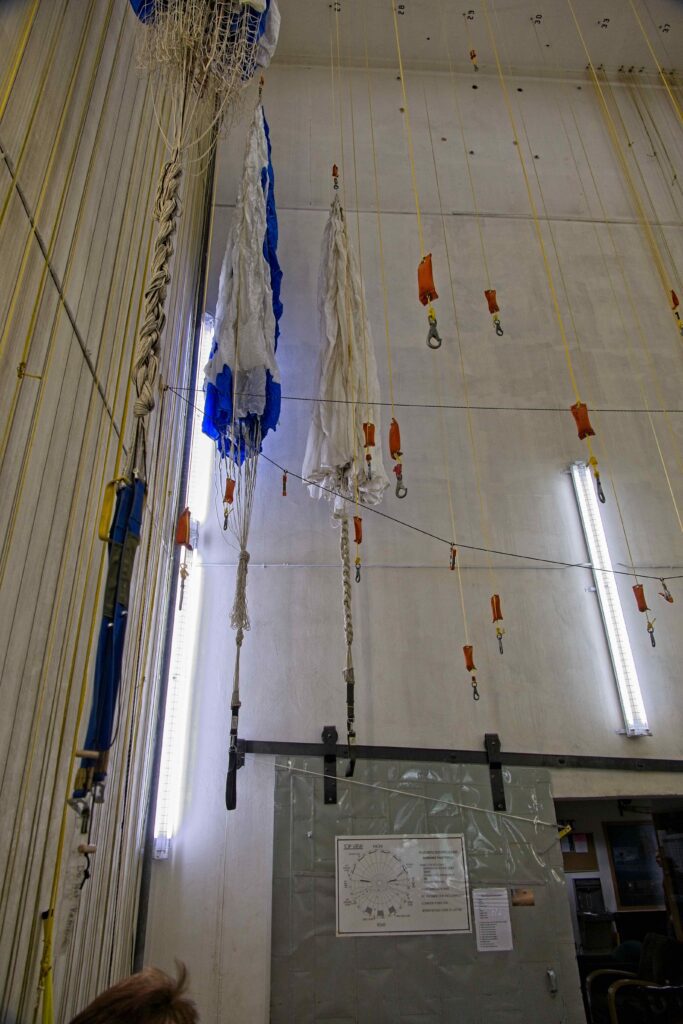
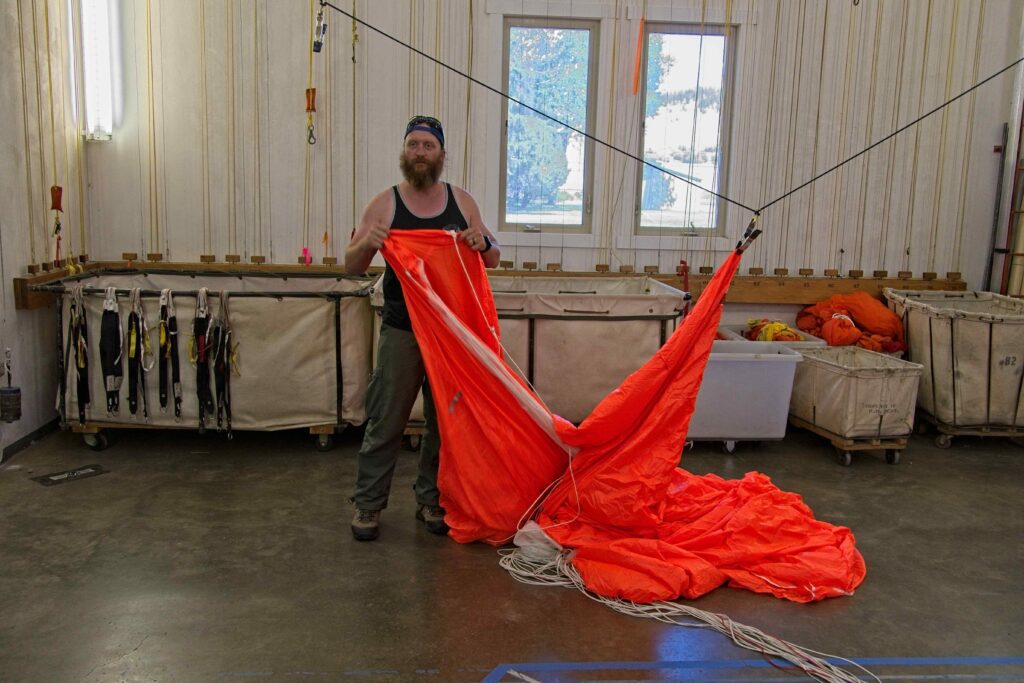
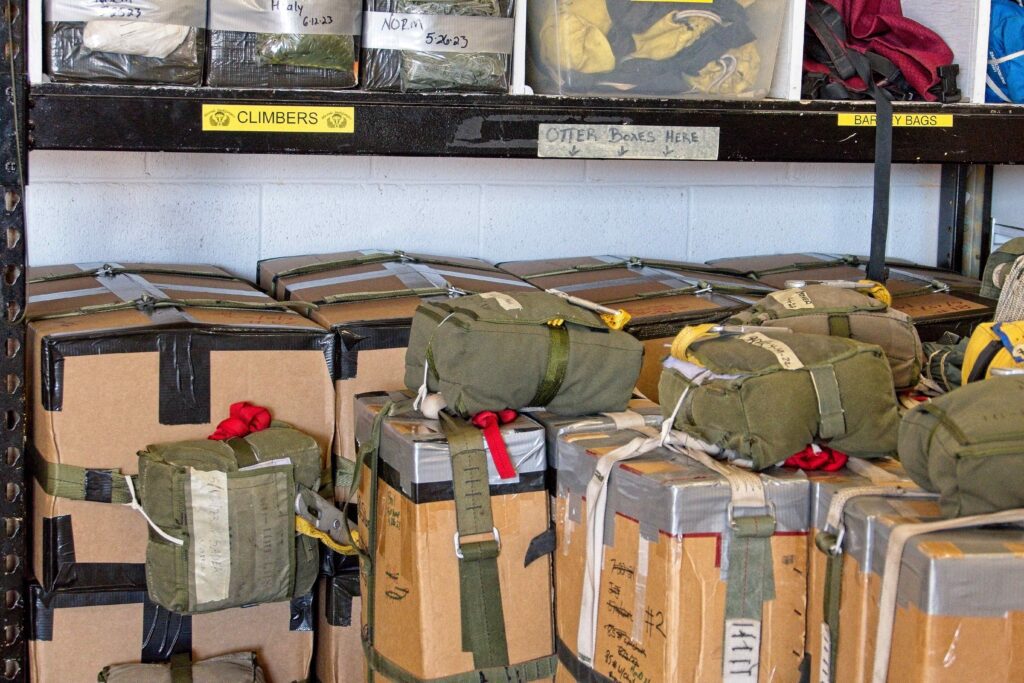
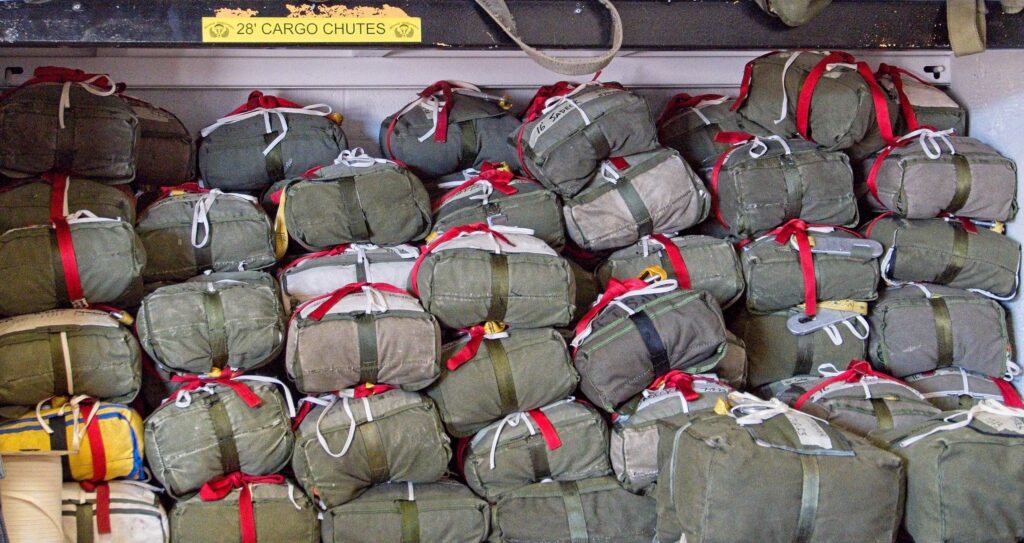
The above photograph of a tree on fire brings back vivid memories. The summer after finishing my freshman year of college in California, I worked as a firefighter in the US Forestry, located in Napa County, California for the summer. Our station was responsible for all the forests surrounding Napa Valley. Had I not gone on to my sophomore year in Texas, I had actually planned to enter the Smokejumpers program.The current day gear of a smokejumper. The outer suit is tear resistant (protects against falling into trees, etc.), and the inner layer is fire and heat-resistant. The gear plus associate tools and supplies weighs more than 120 lbs. A smokejumper but be able to carry this weight for over 3 miles in 90 minutes or less.Locations of Smokejumper stations in the West.We include this graphic for several reasons. First, it is kind of their logo. Secondly, this is the type of parachute employed by most jumpers. We began our tour of the smokejumper facility in this room. This room contains various types of sewing machines. It seems each smokejumper must custom make his/her own suits to fit exactly to his/her physique. This obviously requires learning sewing skills.This next high-ceiling room is used to inspect each and every parachute after use (from an actual fire jump and any practice jump). The two chutes seen here are older (traditional) round chutes. Very few jumpers use the round chute, and they are being phased out by 2026. After this, all jumpers will be required to use the more modern square chute.Scott, our host, displays the process of inspecting a parachute. In rotation, Scott is in the next 6 who will be set to jump into an active fire location. He has 8 years of jumping experience and has made a total of 125 jumps (45 jumps into active fire locations, the rest being practice jumps).As you can see, this is a rectangular chute. It is somewhat smaller than the traditional round chute but is much more maneuverable…a most important feature when dropping into an active fire zone.A better view of the tall ceiling needed to spread out the parachutes for inspection.A view of the packing room. The box in the center is being packed with additional food supplies. It will be loaded and dropped to the 3 smokejumpers working on the Oregon fire.A close inspection of this chart shows the various weight allowances for the four types of aircraft used to ferry jumpers and supplies to active fire locations. Some of you might note they are still using some of the old DC3 aircraft!These boxes contain the supplies, etc. that are dropped once the smokejumpers land safely. Notice how they always have everything is readiness, ready to be deployed on a moment’s notice.More of the “readiness” drop.Still more ready to be dropped. Notice the parachutes are already attached.Last, but not least, the parachutes used for the supplies.This room (and tables) are used to pack each parachute after inspection. The life of a chute is 45 drops. Once folded it is dated and signed by the packer. If not used within 40 days, it must be re-inspected and refolded.The smokejumper in the foreground is packing a “square” chute while the person in the background is packing a round chute. It was made clear to us that each and every smokejumper MUST be proficient in all stages of the various preparations.
DianaNever ever thought about how much ground work is involved in firefighting… the prep is exhausting…then comes the scary, scary part. Thanks for the info!ReplyCancel
HaroldYes, it made me tired just looking at all the gear, much less packing it and then carrying it!ReplyCancel
mao There is a lot of work to these smokejumpers. I have a better appreciation for them, and they are really busy these days. Thanks for sharing!ReplyCancel







DianaNever ever thought about how much ground work is involved in firefighting… the prep is exhausting…then comes the scary, scary part. Thanks for the info!
HaroldYes, it made me tired just looking at all the gear, much less packing it and then carrying it!
mao There is a lot of work to these smokejumpers. I have a better appreciation for them, and they are really busy these days. Thanks for sharing!
HaroldYou’re welcome, MAO
Mary KeaslerSmokejumpers are really special dedicated folks/firefighters. Thanks for sharing.
Harold10-4 on that Mary. Dedication and very hard and dangerous work.
Sherry MaskSo very interesting / can’t believe a parachute can be used 45 times!
HaroldSeeing their inspection and repair system, I would feel comfortable they would last that long.