This is our third day in the Mimbres River Valley in Southwest New Mexico. This valley was home to the Mimbres People, a branch of the Mogollon Culture, from about 200-550 AD until the 12th century.
In her research for this trip, Meriam discovered the Western New Mexico University’s museum (located in Silver City, NM) which has the largest and most complete collection of Mimbres material in existence.
On our visit, we found exquisite pottery, decorated with finely painted geometric and naturalistic designs. The museum is a collection of collections, one of which is the NAN Ranch Collection. It was excavated by students of Texas A&M University from 1978-1989.
Another primary collection is the Eisele Collection collected in the 1920s and 1930s.
This pottery and basketry absolutely blew Meriam and me away! Enjoy!
Disclaimer: I have a new camera and have not assembled all the necessary accessories…one of which is a polarizing filter for the lens.
The WNMU museum has great light for viewing with the human eye. However, the camera’s eye picks up distracting reflections. A polarizing filter helps remove some of the reflections.
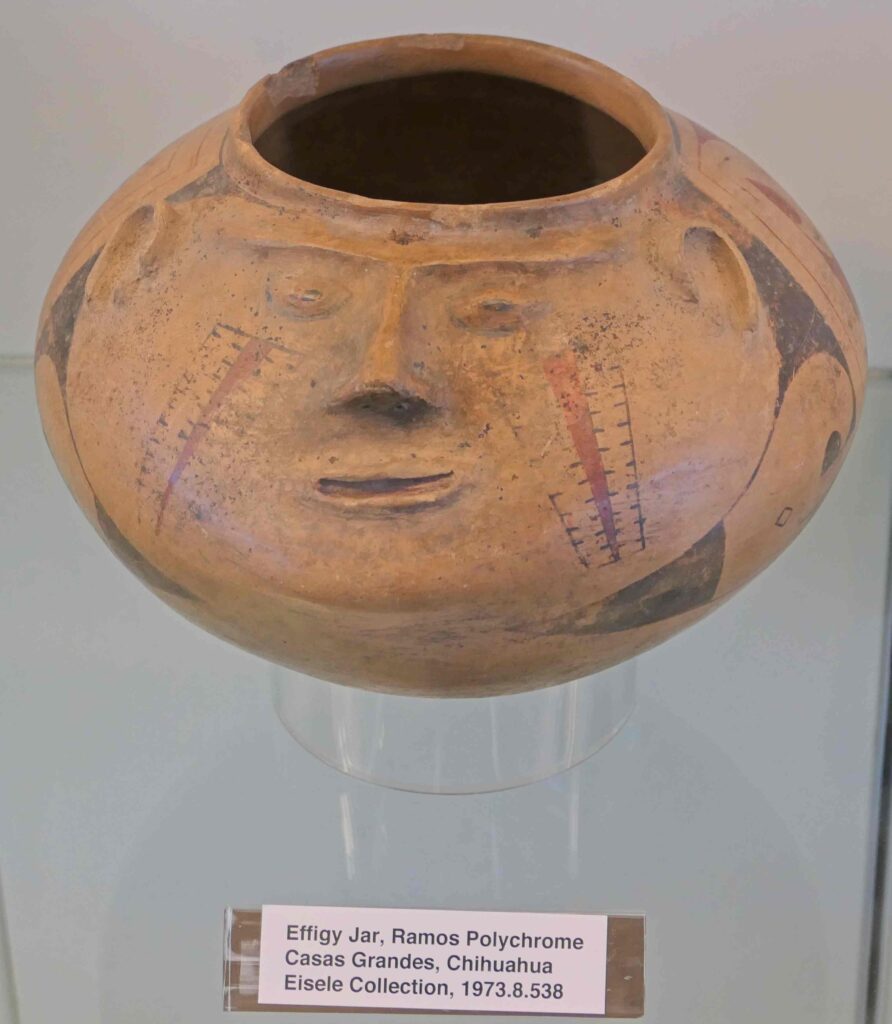
A map where most of the Mimbres artifacts were collected. To orient the reader, Gila Cliff Dwellings are located at the top center of the map. City of Rocks (our first entrance to the Mimbres Valley) is located south of Old Town and before Deming. Silver City is located near the center of the map. The Mimbres Valley, where most of the artifacts were collected, runs from the north-central to south-eastern portion of the map.Richard D Eisele collected over 600 vessels in the 1920-1930s.You will see evidence of the “roping technique” in photographs to come.We had a well-informed student to answer many of our questions. One of the questions was “Why do so many of the pottery pieces have a hole in the center”? She gave four interesting answers/remarks: 1. We don’t know for sure. 2. In their graves, a vessel was turned upside down over their face to possibly allow their spirit to depart. 3. When a vessel no longer held a liquid, the woman made a hole to mark it as such. 4. There is some evidence that modern-day vandals used re-bar to poke a hole in the vessel.Meriam and I have had the opportunity to observe many pieces of pottery from numerous Indian cultures. What we observed with the Mimbres pottery was their exquisite attention to geometric detail, their very fine work, and the incorporation of animals and people in their designs.We have never seen a vessel with this kind of human facial relief!Check out the incredible geometric design.The museum has several rooms with wall after wall of displays like this. Zoom in to investigate your favorite piece.Meriam says: “Harold, I am holding pieces of pottery that was made in 200 AD!”A “touch and feel” table of ancient chards.Check out the relief on the pieces of pottery. The next photograph may provide a pattern from nature.Compare the tree bark to the relief on the chard in Meriam’s right hand.Meriam asked the student to show us her favorite piece. She showed us this piece. The coloring, intricate detail, and execution of its design is amazing…all done centuries before Puebloan pottery.To think a utilitarian basket such as this had all this intricate work.No words are needed here!Harold was intrigued by this basket. While nowhere near the finely crafted previously displayed baskets, its crude workmanship is alluring. A fine example of their roping technique can be seen here. (Please disregard the reflected shadow of Harold’s lower body).
mao I can see lots of ideas for rugs! At one point in my life, I took basketry 101. Mine looked a lot like the one that intrigued Harold! Maybe it’s in a museum somewhere? The collection is amazing. Thanks for the lesson.ReplyCancel
HaroldMAO, we love having your comments. Let us know when you create a representative rug. Maybe the basket IS one of yours!ReplyCancel
Don OatmanThe artistry of these ancient American cultures is amazing! If only Native Americand had invented the wheel and axle.ReplyCancel
HaroldDon, you are so correct. It would have been interesting if history had followed that tack.ReplyCancel
LauraFabulous indeed. The tree bark reminds me of alligator! ReplyCancel





mao I can see lots of ideas for rugs! At one point in my life, I took basketry 101. Mine looked a lot like the one that intrigued Harold! Maybe it’s in a museum somewhere? The collection is amazing. Thanks for the lesson.
HaroldMAO, we love having your comments. Let us know when you create a representative rug. Maybe the basket IS one of yours!
Don OatmanThe artistry of these ancient American cultures is amazing! If only Native Americand had invented the wheel and axle.
HaroldDon, you are so correct. It would have been interesting if history had followed that tack.
LauraFabulous indeed. The tree bark reminds me of alligator!
HaroldThanks, Laura. It does for sure!
Sylvia HuntsmanVery interesting. Great pictures. Thanks
HaroldHello, Sylvia. Thanks for the comment and how are things in the big A?